21 December 2015

Let's get fariki: the life and times of the Matholeng Hog Squad


I have received a number of requests for information about my school’s piggery project. Often these requests come in the form of post-midnight anonymous phone calls which begin with strange, unsteady breathing, followed by such complete silence that I think the call has been lost, and finishing with a loud, bourbon-soaked voice crying, “HOW. ‘BOUT. THEM. HOGS?” In the interest of ending these calls, I’ll give you all a quick, just-the-facts narrative of the project’s life so far.

June 2014
My counterpart (Mr. Shakhane Thamae, as you will recall) attended the Peace Corps Project Design & Management workshop.

August 2014
Shakhane and I held a meeting with community members to determine what they deemed the community’s most pressing needs. The takeaway was that we would build a piggery. I was not satisfied with how the meeting progressed; I felt like the teachers talked too much and the community members too little. This was not a good thing for the very practical reason that a lack of voice might indicate a lack of interest and a lack of buy-in (as we say in the biz), which would be a good way to sink a community project before it launched.

October 2014
We held a second community meeting after I ran through some of the issues I had with the previous one. Mrs. Mathapelo Makoae, my colleague and grade 4 teacher at Matholeng, facilitated the meeting. The community generated a list of 17 needs, then narrowed down the list with an eye towards which needs we could practically address. Eventually, they settled on supporting our Orphans and Vulnerable Children (OVCs). Mrs. Makoae then led them in coming up with ideas for projects which could possibly achieve this. The community members settled on a piggery. This time, however, I felt more confident that this was what they wanted.

December 2014
After a couple of weeks of work with Mrs. Faso, the school’s principal, I submitted our grant application to the Peace Corps for review.

January 2015
We received some comments/suggestions to strengthen our proposal from Peace Corps staff.

February/March 2015
I really wanted to make sure that the project would be economically sustainable, so I spent a lot of time researching expected costs and timetables to try and put together a projected budget for the project. This information is not asked for in the application, which I agree seems like a gap.

April 2015
I submitted the final application through the Peace Corps online grant portal (a device seemingly designed to exclude host country counterparts from involvement in the process – ask me to vent about this some time!).

June 2015
Peace Corps concluded its presumably rigorous and time-consuming grant review process and put a tidy sum of Maluti into my bank account, which I withdrew and kept in a black attaché case handcuffed to my wrist.

July 2015
Shakhane and I bought the construction materials from a local hardware store.

August 2015
Part of the Peace Corps grant agreement is that the community must put up at least 25% of the project cost, which can be given in cash or as an in-kind contribution of labor or materials. Our in-kind contribution consisted of gathering and transporting sandy soil and stones for construction of the sty. For a few weeks, the children would come together after school to carry big stones from past the soccer ground all the way to the garden.

September 2015
The contractors finished construction of the sty.

October 2015
Mrs. Faso and I purchased the pigs, 500 kg of pig feed, and medicine.

Of course, the project is over only insofar as my own involvement goes; hopefully, it will continue and eventually provide funds to assist our OVCs.


Lifariki li teng.

09 November 2015

Climbing up Thanthanyana

I've been derelict in my duty and did not tell you all about my new host brother Liteboho, who has been here at the Thamae compound for at least 6 weeks. He is a lot of fun and is going to start high school next year.

The tallest mountain behind my village is called Thanthanyana (I bet someone out there even knows what it means!), and I've always wanted to climb it (in a very lackadaisical, maybe-I'll-climb-it, maybe-I-won't way). But on Saturday, I brought up that I'd like to attempt it, and Liteboho said he would accompany me. So I found myself committing to climb on Sunday. I'll give you the full run down over the plate of buffalo wings and cold American lager you're all probably just itching to buy me, but here are a few highlight photos, including Springboks (matsa) and me trying out my camera's panorama function.


07 October 2015

Some random observations

Here's a few things that have happened recently. The first two are about sheep.
1) Twice in the past two days, a very young sheep has wandered into my empty classroom while I was sitting at my desk. The first day, it poked around the student desks and made a few contented bleats before eventually leaving of its own accord. The second day, 'M'e Sekatle (you will remember as the teacher of grade 2), called out to me "Ntate Rethabile! You have got a new learner!" Then, a boy in grade 2 came in, made a few conciliatory noises, coaxed the sheep into his arms, and brought it back outside. I wish this happened every day of my life.
2) I was riding a taxi to Ha Sekake yesterday when we pulled up on the narrow shoulder next to a young sheep (perhaps an age mate of the fellow from school). The conductor jumped out, peered around up and down the surrounding mountains, scooped up the sheep, and hopped back into the taxi. I eyed the other passengers to see if this was all on the up-and-up, but wasn't able to tell. Then, the driver spotted a herd of sheep hidden in a fold of the mountain to our right, and inquired whether the herder was missing one of his flock. We drove about two minutes on, stopped, and the conductor cajoled an old man passing by to accept the sheep.
3) Tuesday was an exceptionally clear day, and I was staring out at the mountains when I noticed a few protuberances on the western slope of the largest mountain. I grabbed my binoculars and got a better look. Turns out there are quite a few houses up there, along with a road cut into the side of the high peaks. I'd never noticed this before. It's fun to learn something new!
4) Today, a student in class 6 asked me to use the pencil sharpener (I have said many times that they are free to use the pencil sharpener whenever they like, but they insist on asking. This is one of those things you just have to accept). I was writing on the board, and over my shoulder I heard her panicked cry: "SIR! It is not there!" Her tone of voice was what you would use if you'd just discovered the Mona Lisa had gone missing under your watch.
5) Yesterday, my principal 'M'e Faso and I selected three of the finest, choicest hogs in Ha Sekake to bring home to school, along with a healthy 500 kilograms of Pig Grower (accept no substitutes!). This is the final step of the first phase of my community's secondary project, and I couldn't be happier to see it underway. While I won't be able to see these three get to producing beautiful litters (I'm told the pig-stork brings them), I am excited to see Caliban, Mrs. Prendergast, and Herbert Hooves-er making themselves at home. I hope to make a blog post which gets into the nitty-gritty of the secondary project process.
6) I am four days away from the two-year mark here in Lesotho, and I've reached that stage of equanimity which one feels at the end of things. As you would do in my place, I spend my free time reading Ecclesiastes, picking up soil from the yard and then letting it fall from my stretched fingers into the breeze while making a deep, knowing "mmmmm" noise, and drinking tumblerfuls of bourbon as I sit on my stoop and squint at the setting sun.

02 July 2015

English Club

At the beginning of this school year, I taught the grades 3 and 4 together. A few lessons in, it became apparent that only one or two of the students in grade 4 could read anything at all, and none of the students in grade 3. This was a problem, because the topics and assignments in the government curricula for grades 3 and 4 clearly expected some level of literacy. I talked with ‘M’e Makoae, their class teacher, and she said it would be ok if I organized them into small groups and worked with them on reading and writing during the morning and lunch breaks. So, from about February on, I’d work with 3 or 4 grade 3 students during the morning break, and 3 or 4 grade 4 students during the lunch break.

We began by just copying out the alphabet a few times to get familiar with the letters, and then went on to working through the 7 sets of letter sounds I found in the grade 4 Teacher’s Guide. I’ll stress here that this English Club was not informed by any broad overarching strategy, and more by a sense of desperation that these students were far behind where they should have been, and it didn’t seem like anyone was going to do anything to get them back on track (because so much emphasis is placed on the results of the Primary School Leaving Examination that all grade 7 students take, the school values their instruction far more highly than that of the lower grades – often a student will coast through the early years without learning a whole lot, only to have a stressful final year during which they learn all of the grade 7 material in addition to everything they missed on the way up [this approach is in accordance with the principle that when you build a house, you don’t need to work too hard on the foundation, the floors, the walls, or the rafters, but you should make sure you have a really pretty roof (hope I don’t sound bitter!)]).

I can’t say then that this was an A+ effort on my part and all of the students who couldn’t read at the beginning of the year are now highly literate. It took us a while to find a groove in terms of making measurable progress. But there were positive effects. The students really seemed to benefit from the smaller-group instruction, which had the ancillary effect of making classroom management and learning during the scheduled English classes a lot easier. I got the impression that the students became more comfortable with me as a teacher because they’d gotten to work with me in another environment in which they could sort of understand what we were trying to do, rather than having their sole experience with me be the class time, where I may have just been the loud frustrated sweating man speaking in tongues.

By the end of the semester, a fair number of students (maybe half  of grade 4 and a quarter of grade 3) were able to read most of what they saw in the first portion of Hop on Pop. Progress! My favorite page of the book is of course “HE. ME. He is after me. JIM. HIM. Jim is after him.” It doesn’t get any better than that.


So we’ll see where the next semester takes us, but it’s been a fun learning experience.


"Ah, sir, you can draw!"

The coliseum.

01 July 2015

Cool short film about English-medium education

My close personal friend Andrew "Andy" Maguire sent me this link to a movie made my some secondary school students in Zanzibar. It relates to some of the things I talked about in this post: http://dftmk.blogspot.com/2014/12/what-exactly-am-i-doing-here.html

Watch the movie here:
http://www.npr.org/sections/goatsandsoda/2015/06/25/417174187/teens-make-film-in-broken-english-to-explain-why-theyll-fail-english

15 May 2015

A half-hearted excuse for why I've been delinquent in posting

Friend of the People Mike Middleton recently sent me a box full of books (thanks, Mike!) and among them was Peter Matthiessen's The Tree Where Man Was Born.

In one part, Matthiessen writes about one of the people he's going to visit out in some rural station (the book takes place in East Africa): "But a letter sent me in Nairobi gave me confidence that we would get on all right: 'I think if you allow yourself two weeks here,' he wrote in part, 'you would be able to get a fair insight into the valley and its mysteries; if you stay longer, you might well end up at my position, knowing nothing at all. It seems the longer one stays at a place, the less one has to say about it.'"

That seems like a pretty good description of where I'm at now: I know nothing at all. Not in a bad, despairing way (some of my best friends know nothing at all).

But it could also be apathy. I'll try to get some more posts up over the coming months, possibly dealing with some of the following topics:

  • a visit from my family back in December-January
  • a visit from friends to Cape Town
  • my new fascination with making charts for my classroom
  • something on my secondary project
  • the English Club
  • a searing indictment of the cows and chickens who, with blatant disregard for property rights, ate all of the spinach from my garden (and cut down the okra before it even had a chance)


26 February 2015

A visit from Dylan

My good friend Dylan Riessen came and visited during December. He's working in Cape Town this year for Grassroot Soccer (GRS), and was able to come out during the holiday break. We had a terrific trip in Lesotho and South Africa, and were accompanied by fellow PCV Mary and other GRS intern Sam. No pictures are currently known to exist of the South Africa portion, but I will update this post if I receive any new information. Maybe some day you'll run into me or Dylan and we'll tell you all about it. One highlight was our rental car, a Nissan Hardbody. See if you can spot it.

UPDATE: Mary has found a picture from South Africa.

Dylan took a picture of me in my natural habitat.
http://youtu.be/hQo1HIcSVtg?t=49s
"To drivin' some of the hottest cars New York has ever seen."
Michelle (my fellow volunteer who lives in the area), Sam, and I in a big cave.
Dylan and I outside the cave.
Atop a mountain in Sehlabathebe National Park.
Scenic overlook. It was just overlooking some waterfalls or something.
But take a look at that Hardbody!
The mighty Senqu River.
Hardbody, just glistening in the sun on a beautiful day.
Fog, Hardbody, tents at Sehlabathebe National Park.
Dylan and Mike, cooking up some old fashioned "Sauce and Cheese."
Do they have horses at Sehlabathebe National Park? You bet!
On our way to Tsoelikane Falls, ascending a hill with a fine rock outcropping.
Tsoelikane Falls. The water was cold.
Look at that!
Sam reading in the Hardbody.
The mountain behind my rondavel with some clouds lit by the setting sun.
Dylan doing an honest day's washing.
When my host father heard we were going to town and then saw how dirty
 the Hardbody was, he said "The know me in town, and they know I do not
 like things to be dirty." Together, we gave the Hardbody a thorough cleaning.
Dylan and I, Christmas Eve.
Mary and I, at the beach in Durban.

14 February 2015

Gardening

Back in December, I decided it was time to get my act together and start gardening. I chose to build a keyhole garden, which is a garden inside a circular stone enclosure about waist-high. These gardens were originally designed to help people living with HIV/AIDS grow nutritious foods without the strain of constantly bending down. With the help of some neighborhood kids, I built the stone enclosure and then filled it with the proper layers: crushed tin cans, chopped-up aloe, and then, repeating until full, ash, manure, and soil. My host father helped me to plant the seeds (I truly know nothing about gardening), and I have finally been reaping the rewards these past few weeks with fresh spinach in all of my meals.

I enjoy going out to water my garden in the mornings and evenings and, when the mood strikes me, loudly proclaiming to no one in particular, "Ah! But it is good to work with one's hands!" or "Can there be anything finer than tending one's garden?"

Look at that soil!

The cinderblock structure on the right is my rondavel, for reference.

29 September 2014

Sometimes I work for lions

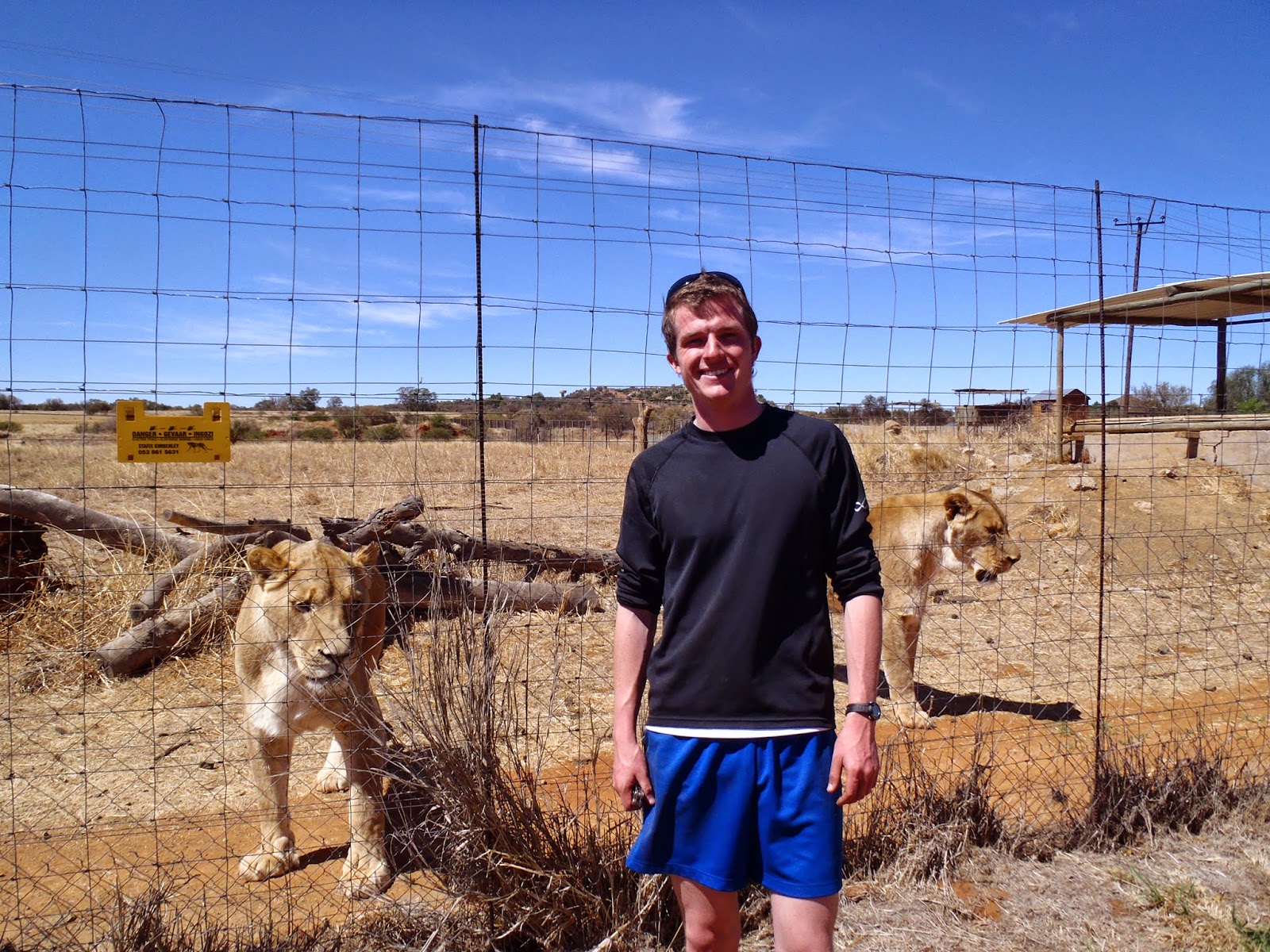
During consolidation, volunteers had the opportunity to volunteer (do those guys ever turn it off?) at a local tourist attraction, Cheetah Experience. I was on the crew that put tires in front of the fence surrounding one of the lion enclosures and then put dirt in the tires. Here are some pictures with me and the boys.

This will be the album art for my next hip-hop single.

Stamping dirt into tires. The lions are bored.

A lost month

On the last Saturday in August, all volunteers in Lesotho received a message from the office in Maseru that there’d been some fighting in the capital, and that the army had surrounded police stations in Maseru and disarmed the police officers inside. This was called a “coup attempt” in the media, which was then changed to an “alleged coup attempt” after the man who attempted the coup, army commander Gen. Kamoli, said that this was all a misunderstanding, and that what had seemed like a coup attempt was actually a preemptive move against factions within the police who were planning on arming participants in Monday’s protest (Did you not hear about Monday’s protest? I believe it was against Prime Minister Thomas Thabane, who had closed down Parliament in June in order to avoid a vote of no confidence, acting in accordance with the principle that no one can really lose a game of Monopoly if all of the little houses and iron figures are scattered over the floor of the den). Whatever happened, it was not a good thing.

So within a few days (and I’m going to keep the details purposefully hazy here because the details of Peace Corps emergency processes probably do not need to be on the internet), all volunteers were whisked out of the country to a number of secure, secret locations (The secure, secret location I was personally whisked to was close to a place that sold great milkshakes). We waited at this location for a period of time, and then, after no good news from the Mountain Kingdom, all volunteers were moved to a single secure, secret location, which happened to be a very nice hotel.

The days that followed were strange and long. On the one hand, it was nice to be in a place with five meals a day, a bar, a pool, a movie theater, and a machine that, at the touch of a button, would give you coffee, café au lait, espresso, or cappuccino. On the other hand, there was a pervasive purgatorial feel to the whole thing, compounded by the fact that we would only find out what was happening a few days at a time, usually receiving an update like “no news good or bad from Lesotho, and we will be making a decision on X.” And then X would come and the update would be repeated.


So it was very exciting when we finally got word that we would be coming back to Lesotho. It was a very big adjustment to come back to Matholeng after three-ish weeks away, but I am getting back into the swing of things. It’s nice to be back, but I also feel as if I’ve suddenly lost a month from my Peace Corps service. It seems like everything has settled down here (not that there were any troubles outside of Maseru, really), and I’m hoping there are no further disruptions.

20 August 2014

Working in the yard

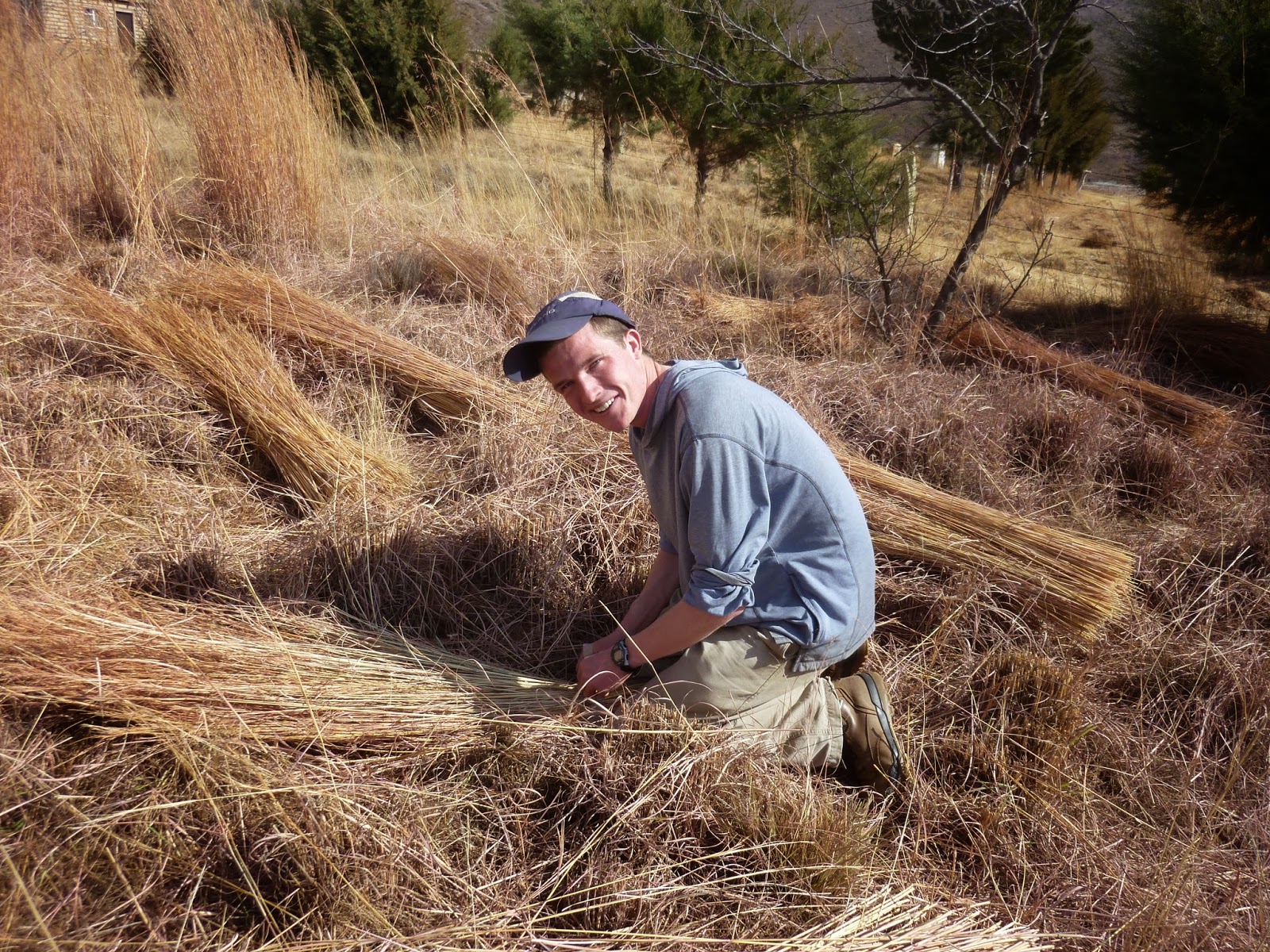
Since arriving in Matholeng, I have periodically asked my host father if I could help him out in the yard. I often feel pretty soft as a PCV, as everyone else in my village seems to have something to do all of the time, and I, once I've finished the school day, basically lounge around reading and feeding myself. This is not, by itself, a bad thing, but when you are the only person lounging, you start to feel like maybe you could be doing something useful. So I was very excited a few weekends back when my host father finally asked me to come help him.

He was cutting grass in the yard to sell for roof-thatching, and he invited my to come tie the grass into bundles. He even suggested that I take some pictures.


29 July 2014

Not catching fish

On Sunday, I finally got to go on a hike down to the river with Tumane, Likhetho, and Kamohelo. They told me that we probably wouldn't see any fish, it being winter and all, so we left the spears at home. It was about two hour's vigorous walk from Matholeng to the riverbed, and the boys were happy to point out sites that they considered photo-worthy. I'm putting up a small sampling of the photos:


At one point as we were walking down the valley, the boys pointed to a cave where, they said, lipila (dee-peel-uh) probably lived. I do not know what lipila are, but the boys told me they are small creatures who, if they see your exposed ears, will bite them and never let go. Tumane pinched his ear between his knuckles and said, "like a padlock." They suggested that I put my hat back on to protect my ears. I did so, and gave them a solemn nod to show them I understood the seriousness of the situation. We never did see any lipila, but we did see some of their tracks.
Cover those ears!
And here's a picture of your correspondent standing on a rock:

Our next adventure, the boys tell me, will be to a site where we can see cave paintings from the Khoi-San people who lived here before I did (I understand there have also been some other people in between us). Can't wait!

25 July 2014

Lilotho

The other day, I was walking with a friend from my village, Kapari, and he told me that one thing that could help me in my Sesotho studies would be to learn some lilotho, which are riddles. I asked my students to write some down, and they came up with this list.

I even understand two of them!
My favorite one is number 13: "Litsoene tse peli li hloa thaba empa li sa fihlelle ka'holmo." This translates to: two monkeys are climbing a mountain, but they do not arrive to the top.

The answer is: "litsebe," which means "ears." Ha!

The other one I understand is number 5: "'M'e o sekoti, ntate o khopo, bana bese ba bararo." This means: "The mother is the basin, the father is the lid, and their children are three."

The answer is: "sekoaelo, pitsa, maoto a mararo," which is a kind of three-legged pot that people use to cook over open fires.

The cutting edge

Prospective volunteers can sometimes be a little anxious about how well they will be taken care of once they arrive to their country of service. I cannot speak of other countries, but I can tell you that the technophiles of Peace Corps/Lesotho deploy an impressive suite of modern technology to help facilitate volunteer care, as evidenced by this quotation from an actual email I received today from the medical office: "In the effort of serving you better we made some modifications sometime back about how you could contact us at the Medical Unit.  This scenario was tried and tested, and it was felt that we needed one more thing to make it easier and accessible for all- an answering machine."

10 July 2014

Honest Abe and climate change

Well, I told you that I’d have some more quotations from Abraham Lincoln for you, and I don’t intend to disappoint. This one is from the same speech to a Springfield, Illinois temperance society. “Few can be induced to labor exclusively for posterity, and none will do it enthusiastically. Posterity has done nothing for us; and theorize on it as we may, practically we shall do very little for it, unless we are made to think we are at the same time doing something for ourselves.”

One of the observations you will often see in discussions about climate change is the disproportionate burden borne by developing countries, that often the countries least responsible for contributing to increased levels of carbon dioxide in the atmosphere are most affected by the unpredictable weather patterns those increases create.

In the United States, many of the things we can do to reduce our carbon footprint (driving less, eating responsibly-produced food, etc.) are not immediately beneficial to us and so must fall under the category of “labor exclusively for posterity.” Even things that might benefit us directly (lower electric bills if you have a solar set-up) still have steep up-front costs (the thousands and thousands of dollars you need to spend to get a solar set-up). So, as Pres. Lincoln notes, few have been induced.

But in Lesotho, two factors combine to make any labor done to adapt to climate change (and note that the option in regions with already minimal footprints is simply to adapt) not labor for posterity but labor for self.

One: the effects have already been noticed. Whether or not these specific weather patterns can be causally linked to rising carbon dioxide levels, most people here note that something abnormal is going on. I arrived on the heels of a six-month drought, and Shakhane (my counterpart/the Grade 5 teacher) told me that planting had been delayed two months from its normal time. Adapting to the changing climate is not something you should do for your children, it is something you must do for yourself.

Two: the strategies for adapting to climate change (at least that I’ve seen) have the additional benefit of making one’s daily life easier. I use a propane-powered stove, but many people in Matholeng burn wood. My propane tank, full, weighs 11.3 kg, or just under 25 lbs. I grunt and sweat and complain every time I have to lug a new one from the road up the mountain to my house. But one tank—which must provide fuel to cook all my food, boil all my drinking water, and heat the water for my bucket baths—lasts about 40 days. I don’t have to carry that propane tank very often.

I am not sure how long it takes to burn through 25 lbs of wood, but I imagine it’s a great deal shorter than 40 days. My host father, ntate Matlere Thamae, works at the local NGO as its Climate Change Resource Officer. One of his newest initiatives is to sell wood-burning stoves to people in the surrounding villages. These stoves come in three different sizes and, he has told me, are about 80% more efficient than putting your wood fire out in the open. This would be a very small step to mitigate the effects of climate change, but more importantly, the purchaser would now have to carry 80% less wood. Their labor benefits posterity, but they are, in a very real, palpable way, “at the same time doing something for [them]selves.”

 
Ntate Matlere with some of the new stoves.

80 per cent. We're talking about per cent here.

And reducing the use of wood would have a tremendous ripple effect. Trees are naturally very important because of their ability to eat carbon dioxide and poop oxygen (you may be wondering how I got so smart at science, and let me tell you that I have quite the background; I once took a class called “Chemistry for Citizens”). More oxygen and less carbon dioxide is a good thing for us humans. But let’s take it local.

In Lesotho, one of the greatest environmental concerns is the pervasive soil erosion. The entire country is a high mountain plateau, and most of our rain finds its way into the Senqu River and then out into South Africa. Large ditches called dongas scar the countryside where the water streams down from the mountains. There are very few trees to keep the soil in place, so much of the fertile topsoil gets carried away. Plenty of people and organizations have tried to remedy this by planting trees, but it is difficult to convince those who live in nearby villages to let those trees be. When confronted with the immediate need of fuel to cook food with, the slightly longer-term need of fertile topsoil gets swept aside. If 80% more trees are left where they stand, more soil will be left in place.

Which brings us to food security. Shakhane recently attended a government workshop for 5th-grade teachers and high school agriculture teachers about a new method of farming called “Conservation agriculture.” This is another approach that, while it will certainly be beneficial to posterity, it is also immediately, tangibly beneficial to people living in Lesotho today (even shorter term than just the better crop yields they might see). I am thinking specifically of the 1st Principle of Conservation Agriculture: minimum soil disturbance. This helps to protect the soil from erosion and conserves soil moisture, but what it practically means is that you no longer have to hoe the fields to break up the soil before planting. (I have heard that) hoeing is very difficult work, and the other teachers readily approved of the new approach.

This is a very high-quality pamphlet.

Spend less time disturbing the soil and more time with your kids. Win win.

One of the main points of Peace Corps service is to build capacity, which entails the transfer of any skills the volunteer might have to members of the local population, so that the locals may use those skills long after the volunteer has left. So I would have been remiss in my duty if I had not suggested an approach to dealing with climate change that has been useful in America. “Have you tried,” I asked, “denying it?”

“Denying what?”

“Climate change. You know, you could just say that it’s not happening.”

“But it is happening.”

“Yes, but… what if it weren’t?”

“But it is.”

“Look, I believe that you believe that. But, and bear with me here: what if it weren’t?”

(looking around at others) “Does anyone know what he’s talking about?”